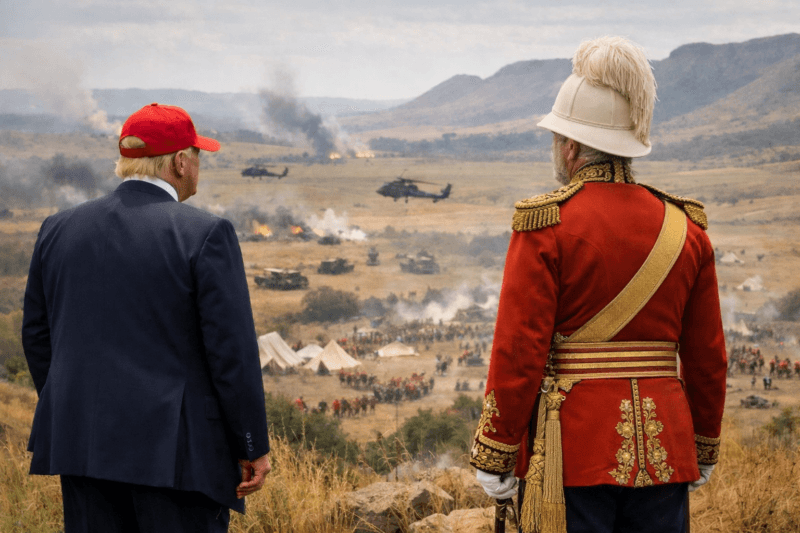
At the time of writing (12 March) the Iran conflict is stuck. The US has done most of what it (retrospectively) said it wanted to do. Isreal is keen to carry on. The IRGC shows no sign of giving up. Any resistance in Iran remains unarmed. Almost no oil is leaving the Gulf. What might history teach us?
Technical innovation makes war more risky because nations embrace new weapons but are slower to change how their forces fight which in military parlance is ‘doctrine’.
In 1879, at Isandlwana the British had a new more rapid firing rifle which conferred huge advantage, but they were defeated partly they had to work out what those advantages meant for their wider doctrine.
In 2026, impressive US/Israeli shock and awe has disabled Iranian air defence and command control which created favourable conditions for ground forces, but none were intended. Meanwhile, the delegation of firing authority to IRGC missile and drone sub-units puts the US in a worse position. It undermines the central logic of US war-fighting doctrine, which holds that destroying ‘the centre’ renders outlier units helpless. Not in Iran, where it does make each unit more vulnerable, but Iran as a whole more resilient.
President Trump would like to declare victory, but the reduction in Iran’s strike capacity is asymptotic; the first 80% of a reduction is much easier than the last 1%. Indeed, an asymptote never reaches ‘zero’, and the war is not over if Iran ‘only’ achieves a few strikes on neighbours and ships each month.
The US is making ad hoc adaptations to its fighting doctrine to counter weaponised drones despite the fact that the military value of drones was demonstrated by ISIS a decade ago. The US Navy is well prepared to fight a peer navy, like Russia or China, but is now less able to engage low-tech Iran at close quarters in the Straits of Hormuz because it is risky. Eventually, someone will ask what the US Navy is being preserved for if oil does not flow.
Lord Chelmsford did adapt after his defeat in January 1879, and his second invasion of Zululand in April was quite different and very efficient. The US Navy is an impressive force, but being larger and more complex, changes will be harder to make.
Neither President Trump in 2026 nor Sir Bartle Frere in 1879 ‘Selected and Maintained the Aim’, which is a long-held principle of war. In 1879, King Cetshwayo of the Zulus was restored to power just three years after he was defeated. Likewise, an undefeated Iran is a perfectly plausible outcome.
So what is next?
Almost certainly, America has to intervene on the ground if it wants to stop all missile, drone and mine launches. The fact that each IRGC sub-command is operating independently makes their complete elimination an enormous task.
Or Iran capitulates, which is unlikely. The IRGC continues to successfully damage the global economy, their leader’s family has been killed, and their grip on power in Iran shows few meaningful cracks. Even if young liberals took over the main Iranian cities, IRGC subunits in the regions would carry on. Regime collapse in Tehran does not solve Trump’s immediate problem, nor does it solve that of his Gulf allies.
The US attack on Iran separated Gulf oil suppliers from their Asian customers. Roughly 90% of oil going through the Straits of Hormuz comes from non-Iranian Gulf States, and about 90% of that goes to Asia (37% to China). Iran hints it would not attack oil heading to China? Will the US Navy block oil from Iran heading to China, but let it through if it comes from Saudi Arabia? Messy. Naval blockades, like that imposed during the Cuban Missile Crisis, are almost by definition potential pathways for escalation.
Iran wants the US to leave its bases in the region, and Gulf states faith in US security has been shattered. One to watch.
This article has attempted some serious analysis but has also suggested a connection between history and past events. Amashinga, is a documentary about the geopolitical context of the Anglo Zulu War of 1879. The film screens at Rheged in Penrith on 20 March and the Q and A afterwards will examine the modern relevance of those lessons.
More links to material on Analysis History.
The Case for History; 2019 as 1879