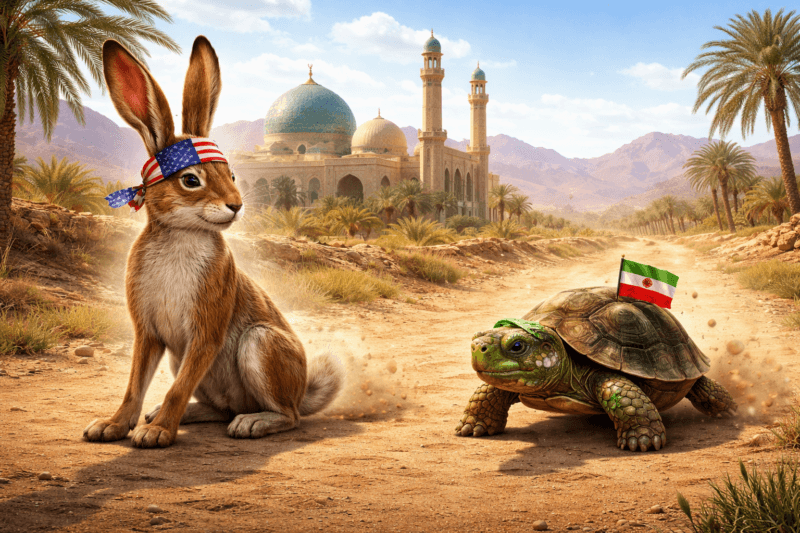
IRGC decision makers in Iran are thinking about what history teaches them.
In the early 1980s, Iran wanted to extend the influence of their Islamic revolution to the Shia of South Lebanon. Their proxy was the newly formed Hezbollah, which was formed to resist an Israeli ground invasion of Lebanon. Iran and Hezbollah had divergent goals, but one they shared was to drive a mostly American peacekeeping force out of Lebanon. At the time, Iran was at war with Iraq, which the United States was supporting.
President Reagan said the United States would not “cut and run,” but in 1983, two suicide truck bombs caused hundreds of US casualties, and he then did exactly that. This happened, even though the US had a state-of-the-art naval fleet offshore Lebanon, which fired at targets throughout Lebanon at no risk to itself. Conversely, Iran had plenty of well motivated volunteers in Hezbollah and low-tech IEDs. Then, as now, the fighting was very much the ‘hare versus the tortoise’. Despite the hare’s rapid speed of response, huge firepower and relative safety, it lacked endurance, so all the tortoise had to do was keep going.
Presently, thousands of US/Israeli air raids have delivered much destruction in Iran in return for little strategic progress. On the other hand, fewer lower-tech strikes on neighbours’ oil assets have transformed the Iranian position so it controls which oil leaves the Gulf and, in effect, where that oil goes. The Iranians know, because President Trump tells them, the Americans could leave just as they did from Lebanon in 1983. IRGC commanders direct personal experience is telling them to keep going.
At the same time, theories of war largely fail when one participant decides to martyr an entire nation for little obvious domestic benefit. However, Shia history highlights exclusion by a dominant Sunni establishment. There are many modern echoes of that narrative given relatively poor Shia Iran sits alongside fabulously wealthy Sunni Gulf states. For example, the late Ayatollah Khamenei is being called ‘the modern Ali’ who was the original Shia caliph; the Shia caliphate unlike the Sunni tradition, was hereditary, and the Arabic version of the name Mojtaba is often associated with Ali’s son, Hussein, who in AD 680 allowed himself to be ritually martyred by a wealthy Islamic establishment. In summary, the IRGC are using an historical religious belief system to explain the death of Khamenei, the choice of his son Mojtaba as successor, and by extension the curious targeting of peaceful but dominant Sunni neighbours.
It does not matter that many in Iran do not subscribe to such literal equivalence, because the IRGC enforcers do. An information operation to highlight this anomaly does not feature in the present US strategy.
At the time of writing (Sunday 22 March), financial markets still behave as if the present war could end in days and President Trump and Netanyahu control that choice. I doubt it.