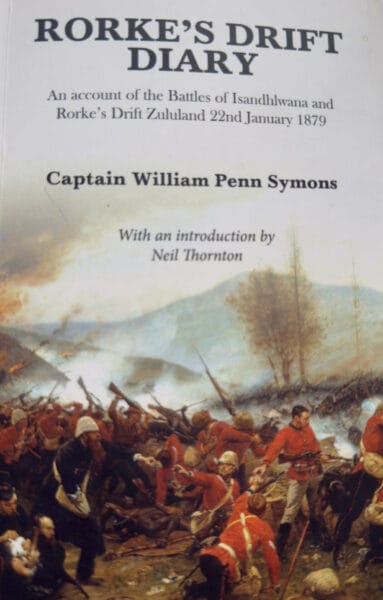
 This post expands on the history of the Anglo Zulu Wars which is a story told in the
  documentary film, Amashinga.
Captain Penn Symons was a company commander in 2/24th and as such was south with Lord Chelmsford when the Britsh Camp at Isandlwana was destroyed. He is not therefore an eye witness to the fighting at either Isandlwana or Rorke’s Drift later that day but he was an immediate witness to the aftermath of both battles. He wrote many of his diary notes from Rorke’s Drift and they reflect what he was being told by survivors in the immediate aftermath.
Most striking is the certainty with which Symons relates that Dunford was told to take command of the camp at Isandlwana. He emphasises this point a number of times; but we now know this was untrue. The letter in which Lord Chelmsford’s staff officer Lieutenant Colonel John Crealock, said he had given that was later found on Durnford’s body. It contained no such instruction. The vehemence with which Penn Symons asserts the opposite strongly suggests that Crealock and perhaps Colonel Glyn’s staff officer Clery, were indeed active in Rorke’s Drift in the aftermath, constructing a narrative of events which they had hoped would absolve themselves and Lord Chelmsford of blame. This is not a new observation. It seems Penn Symons fell under this influence which undermines what might have been a very useful record of events. (Lt Col John Crealock should not be confused with his brother Maj Gen Hope Crealock who also joined the campaign)
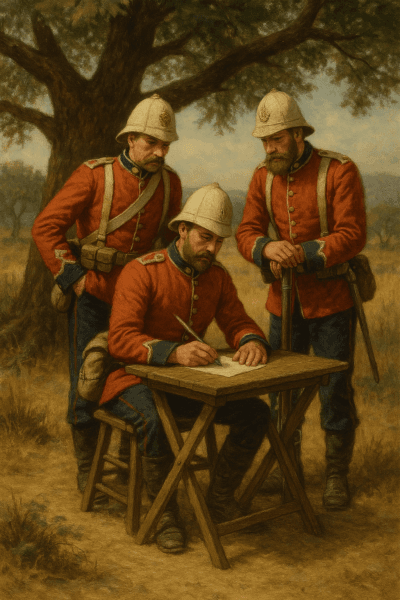
The influence of Crealock on the Symons diary also supports the hypothesis that Lt Chard’s account of the events at Isandlwana on the 22nd was likewise coached. (A point also made here when Chard’s papers came up for sale). Chard’s account is important since he was the only officer who left the camp at Isandlwana by choice whereas others left to survive which may have coloured their accounts.
Symons highlights another controversial issue, the great number of Zulus on the ridge to the north of the camp in the early morning of the 22nd. Was this the Zulu Army right horn already deployed and seeking to envelop the camp? Or were they recce parties of Zulus testing defences and also screening the main Zulu force 7 miles away. Paul Garner battlefield guide and historian to the film Amashinga, believes they were recce parties. If the parties were recce parties then the Zulu Army only arose and attacked the camp when discovered by Lt Raw at about 11am which is the mainstream view. On the other hand Lt Pope who was on the ridge engaging these recce-Zulus early in the day, remarked on their strength. Certainly, Paul Garner is right a Zulu Army would have had no trouble covering the distance from thier resting place to Isandlwana; even if they only moved when discovered at 11 am. But it was also a remarkable and impressive execution of a battle drill from a standing start. They would need to have been laid out in their battle formation, in the valley where they were hiding.
Another second striking point from the diary is that once battle was joined, the firing lines of the 24th remained extended. The gap between each soldiers was large and each firer was not shoulder to shoulder with his neighbour. The option to fall back and form a tight square around the ammunition existed right up to the last moment. Such was the faith in the new Martini Henry rifle that even as large Zulu Armies enveloped the camp, no action was taken. Rather many small groups spontaneously formed last ditch stands and each were overwhelmed. It was assumed the firepower of the new weapons was adequate, and the sort of defensive square that had never been breached in so many previous wars, was not needed.
This represents a failure to properly consider the new doctrines needed to fight with new technology. Drones are having the same effect. Perhaps a decade late The British Army has just realised drones are changing the battlefield but there is piecemeal thought about what it means about everything else an army does. The Telegraph today (14th Feb 216) reports a British brigade was ‘wiped out’ in an Estonian War game by a Ukrainian drone battalion. War is risky when new technology is being adopted. New weapons are enthusiastically adopted but new ways of fighting follow more slowly. In 1879 it was reasonable to discard the British square in many circumstances of defence but as it turned out, not this one. There is no discussion of when a square should or should not be adopted. It was thought to be simply not needed any more.
Symons confirms that Chelmsford did indeed interfere with Glyn the column commander continuously. This partly accounts for the poor layout of the camp. There is also a witness statement by Private Williams of the 1/24th and groom to column commander Colonel Glyn. He said that Captain Coghill who was leaving the battlefield to save the colours told Trooper Williams to flee or he would be killed. This seems like odd advice from an officer himself leaving in circumstances some would question. This statement might have been made up by Williams to excuse his departure. The practice of taking colours into action was banned in 1882 just after this. The topic deserves separate treatment but whilst it was common to hide the colours to avoid their capture, actually leaving the battlefield with them was highly unusual. Encouraging a private soldier to do the same is a step further. Coghill died in this effort after bravely going back to help his comrade Melville and both won VCs.
The Imperial officers who survived, were Captain Essex, Captain Gardner, Lt Cochrane, Lt Curlings (whose words feature in Amashinga) and Lt Smith Dorrien who wrote candid letters (now in the IWM) about his experiences, Captains Melville and Coghill who saved the colours which were found later, but they both died during their effort.
In short the diary is a useful and short read.